
A journey through the history and archaeology of the Roman villa of Santa Catarina de Sítimos
- Discover the history of the site: from the identification of the site to the first archaeological campaigns
- Follow the ongoing archaeological work
- Discover the different areas of the Roman villa
- Learn more about the artefacts that help tell the story of Sítimos

1977 | Discovery of the site
1986 | First archaeological excavations
2006 | Archaeological campaign during which the natatio (swimming pool) was uncovered
2016 | Diagnostic excavation carried out for the renewal of the water supply network, which identified the western limit of the natatio
2019 | Geophysical survey
2024 | Launch of the SITIMUS project – Safeguarding and Enhancement of the Roman Villa of Santa Catarina de Sítimos
1977
The site was discovered in 1977, during works to widen a street in the village of Santa Catarina de Sítimos.
1986
João Carlos Faria was responsible for the first archaeological work carried out at the site.
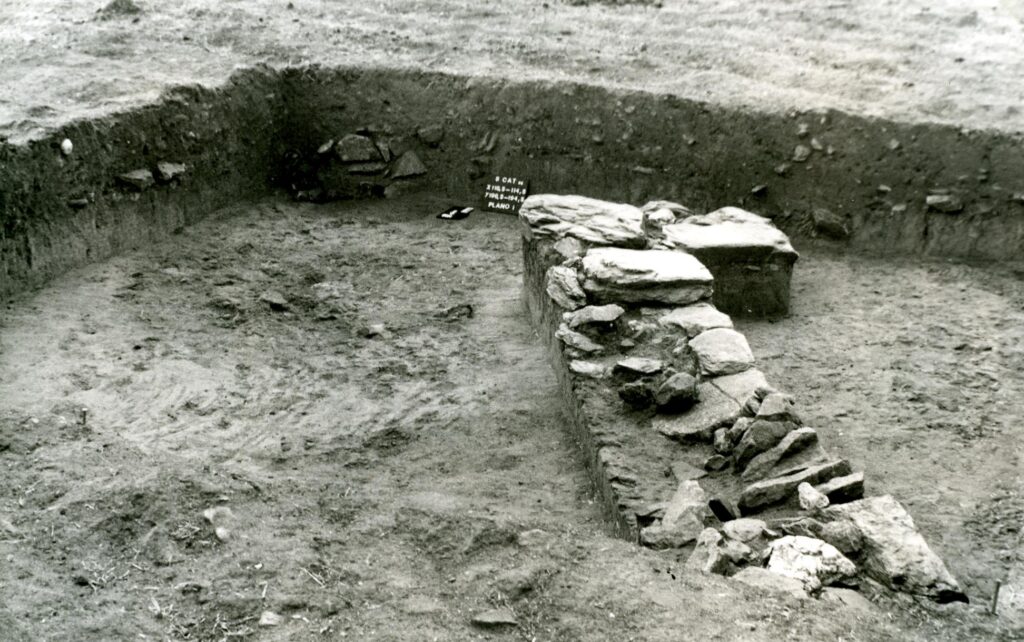
In 1986, João Carlos Faria began the first archaeological campaign. He opened several trial trenches, uncovering a quadrangular tank with a floor and lining of opus signinum, including a quarter-round moulding, and identified an area used as a rubbish dump, where the finds allowed the occupation of the site to be dated between the 1st and 4th centuries AD.
2006
The Alcácer do Sal Municipal Council, under the direction of António Carvalho, carried out further archaeological interventions.

The work focused on two areas:
- Area with a large swimming pool (natatio), possibly part of the baths (Sector A)
- Production building with tanks (Sector B).
2016
Under the coordination of Rita Balona, the Alcácer do Sal Municipal Council carried out a diagnostic excavation for the renewal of the water supply network, which identified the western limit of the natatio.

2019
Cleaning and straightening of the stratigraphic sections, under the coordination of Rita Balona from the Alcácer do Sal Municipal Council.
Geophysical survey.

In the same year, a geophysical survey was carried out by Era – Arqueologia S.A.
2024
Launch of the SITIMUS project, a PIPA (Multiannual Archaeological Research Project) with a four-year research plan.
2025
Second archaeological campaign of the SITIMUS project.
2026
Third archaeological campaign of the SITIMUS project.

The first two excavation campaigns took place in August 2024 and 2025, respectively, and aimed to clean, define, characterise, and extend the two areas previously investigated: the natatio area (Sector A), probably corresponding to the bath complex, and the production area (Sector B), likely associated with an oil or wine press.

The third campaign took place between July and August, continuing the excavation of the two previously investigated areas (Sectors A and B). A new area, Sector C, was also opened to investigate the possible residential area of the villa. Located south of Sector A and selected on the basis of the geophysical survey results, the new excavation area revealed a wall and a significant assemblage of ceramic finds, providing promising evidence for future investigation.
The work carried out so far indicates that this agricultural villa was occupied from the early 1st century AD to the 5th century AD.
Discover the results of the archaeological work…
Explore the different areas of the Roman villa and discover the archaeological work carried out in the sectors currently under investigation.

Objects that tell stories
A writing and archaeological communication exercise based on the AND–BUT–THEREFORE (ABT) model.
