In Archaeology, objects are often presented through descriptions of their characteristics. But can this information be transformed into a story?
This was the challenge set for the students of the ArcheoSpain International Summer School, using the ABT — And, But, Therefore narrative model, proposed by Randy Olson and applied to archaeological communication by Sara Cura in the manual Escrita de Divulgação em Arqueologia (2026).
Using objects found at Santa Catarina de Sítimos, the students experimented with new ways of communicating the stories that Archaeology allows us to tell.
Discover the objects and the stories built around them.
Bone hairpin
In 1986, archaeologists discovered this hairpin carved from animal bone, and hairpins like this one were used to elaborately style the hair of women during the Roman Empire. But it can be nearly as complex to create each hairpin as it is to use it, delicately placing it to pin up hair. Therefore, despite the long process it takes to craft and wear the hairpins, these accessories held a vital role for centuries in both style and society. Women from a range of social classes would use them, for everything from simple buns to beautiful coiffures.
Cheyenne Contreras & Madeline Keiger


Oil lamp
This fragment of a 1st–2nd century moulded oil lamp depicts the Roman goddess Venus bathing. Typical Roman lucernae feature three distinct characteristics: a central oil reservoir, a filling hole, and a decorative top disc, called the discus. On this discus, Venus is depicted partially draped, with a vase on a column beside her, and the presence of this image on an artefact found at Santa Catarina de Sítimos displays how the Romans incorporated religious and mythological motifs into everyday objects.

But, despite this religious iconography, it is difficult to ascertain whether the average Roman Lusitanian viewed this as a symbol of religious worship or simply as an object that facilitated daily living. Therefore, this fragment provides evidence for the widespread circulation of religious and mythological imagery through ordinary material culture. Marlaina Pennington, Frieda White & Lauren Teves Machado
Silver coin
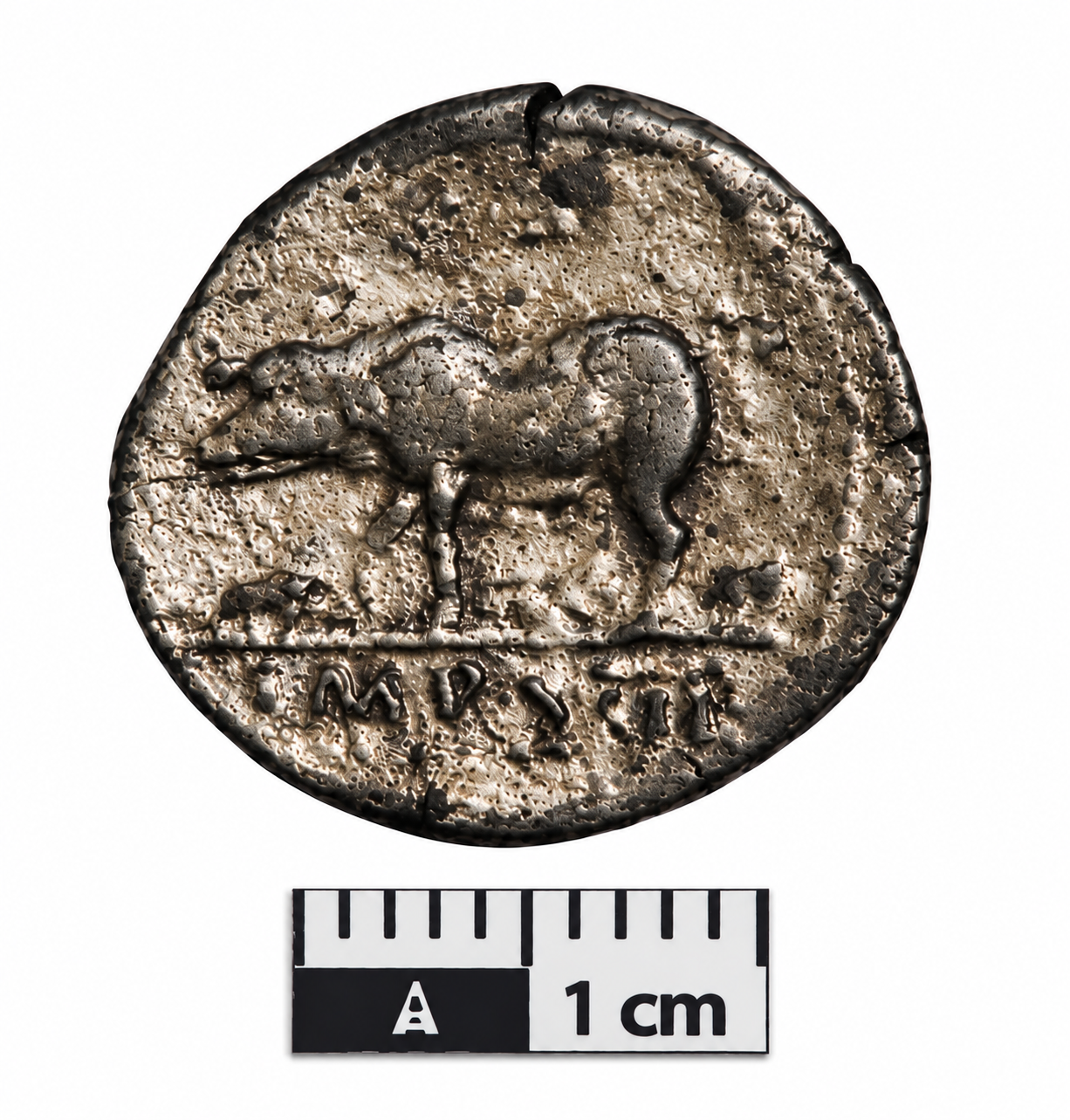
This silver coin shows the head of Titus, son of the Roman emperor Vespasian, on one side and a sow with three piglets with the letters “IMP XIII” on the other. And pigs were popular Roman symbols of prosperity, although this image may also have had other meanings. But the meaning of the image is not entirely clear, although animals and scenes associated with rural life were frequently represented on Roman coins. Therefore, although there is no written evidence that Titus ever visited Lusitania, the discovery of this coin at the villa of Santa Catarina de Sítimos shows the importance of the circulation and exchange networks connecting this western-most part of the empire during the Flavian period.
Lina Marandet & Sabrina Flores